
The World’s Largest Sporting Event Arrives at a Critical Historical Moment
The FIFA World Cup has always been more than football. It is one of the very few events capable of capturing the attention of billions of people simultaneously, transcending borders, languages, religions, and political systems. Yet the 2026 FIFA World Cup, hosted jointly by the United States, Canada, and Mexico, may prove to be significant for reasons that extend far beyond sport.
Author: David R. Hohl
On paper, the tournament is already historic. For the first time, 48 national teams will compete instead of 32. More than 100 matches will be played across three countries, making it the largest World Cup ever organized. However, the true importance of the 2026 World Cup lies elsewhere. It arrives at a moment when the international order is under pressure, geopolitical competition is intensifying, technological disruption is accelerating, and societies around the world are increasingly fragmented by political polarization and information bubbles.
In this context, the World Cup is not merely a sporting competition. It is a mirror reflecting the state of the world itself.
Football as the Last Truly Global Cultural Language
The first quarter of the twenty-first century has been defined by division. Political polarization, social media echo chambers, growing nationalism, and geopolitical rivalries have increasingly fragmented public discourse. Yet football remains one of the few cultural phenomena capable of uniting billions of people around a shared experience. For one month, audiences from every continent will focus on the same stories, emotions, victories, disappointments, and controversies. In a world where common narratives are becoming increasingly rare, the World Cup serves as one of the last genuinely global cultural events.
This matters politically. Shared cultural experiences create informal connections between societies that often remain inaccessible through traditional diplomacy. While football cannot solve geopolitical conflicts, it can create moments of mutual recognition and collective attention that transcend political divides. In an age of fragmentation, the World Cup remains one of humanity’s few remaining global conversations.
North America’s Soft Power Moment
The choice of the United States, Canada, and Mexico as hosts carries considerable geopolitical significance.
The tournament effectively places North America at the center of global attention for an entire month. At a time when democratic societies face growing competition from alternative governance models, the World Cup offers the host nations an opportunity to project stability, openness, diversity, innovation, and organizational capacity.
This is particularly important for the United States.Throughout modern history, major sporting events have served as instruments of soft power. The Olympics, World Expos, and global tournaments allow nations to shape perceptions, strengthen international prestige, and showcase their cultural and economic attractiveness. The 2026 World Cup may become the largest soft-power exercise ever conducted on North American soil.
The First AI World Cup
The tournament is also likely to become the first truly artificial-intelligence-powered World Cup. AI systems will influence everything from crowd management and transportation logistics to security operations, broadcasting, fan engagement, and commercial marketing.
Billions of viewers will consume personalized content generated through increasingly sophisticated algorithms. Real-time translation technologies will reduce language barriers between fans. Smart infrastructure systems will help manage transportation and security on an unprecedented scale.
In many respects, the tournament will serve as a global showcase for technologies that may soon become commonplace in cities, transportation networks, public administration, and large-scale public events. The World Cup will therefore function not only as a sporting event but also as a demonstration of how emerging technologies are reshaping modern societies.
A New Geography of Football and Global Influence
Perhaps the most underappreciated aspect of the 2026 World Cup is what it reveals about changing patterns of global power. For most of the twentieth century, football’s economic, institutional, and cultural center of gravity was overwhelmingly concentrated in Europe and South America. Today, that landscape is changing rapidly.
North America is investing heavily in football infrastructure and professional leagues. The Gulf states have become major investors in clubs, competitions, and broadcasting rights. Asian markets increasingly shape commercial strategies, sponsorships, and audience growth. The expansion to 48 teams reflects this transformation. The tournament is no longer designed exclusively around traditional football powers. It increasingly reflects a multipolar world in which emerging regions demand greater representation and influence.
In this sense, the World Cup mirrors broader trends in international politics and economics. Just as emerging powers seek a larger role in global governance, emerging football nations seek a larger role within the world’s most popular sport. The question is no longer whether football will become more globalized. The question is whether Europe will remain its undisputed center.
Can Sport Influence Global Conflicts?
Sport alone cannot stop wars.
Nevertheless, major sporting events have historically created opportunities for informal dialogue and symbolic diplomacy. Throughout modern history, sporting competitions have often provided neutral spaces where political adversaries could engage without direct confrontation. The 2026 World Cup will take place against the backdrop of ongoing conflicts in Ukraine, instability in the Middle East, and growing strategic competition in the Indo-Pacific region.
No serious observer should expect football to resolve these disputes. Yet the tournament will bring together political leaders, diplomats, business executives, investors, media organizations, and civil society actors from around the world. Informal conversations frequently begin where formal diplomacy reaches its limits. In international affairs, trust is often built gradually through repeated human interaction long before it emerges in official negotiations.
The World Cup’s greatest diplomatic contribution may therefore lie not in grand political breakthroughs but in the countless small connections it helps create.
Migration, Identity, and the Modern Nation
The tournament will also highlight the changing nature of national identity itself. Many of today’s leading national teams are products of migration, multiculturalism, and globalization. Their players frequently represent societies that have become increasingly diverse over recent decades. This reality challenges traditional notions of nationhood while simultaneously demonstrating how shared civic identities can emerge from different cultural backgrounds.
The World Cup has become one of the most visible stages upon which modern societies negotiate questions of identity, belonging, and integration. As such, the tournament offers a glimpse into broader demographic and cultural transformations shaping the twenty-first century.
Who Could Lift the Trophy?
While predicting a World Cup winner remains a hazardous exercise, several nations enter the tournament as clear favorites. Argentina seeks to defend its title and remains among the strongest teams in international football. France continues to possess one of the deepest talent pools in the world, while Spain arrives with momentum and a new generation capable of dominating possession-based football at the highest level. Brazil remains football’s most iconic nation and can never be discounted, while England may view this tournament as its best opportunity in decades to transform potential into silverware. Germany, despite recent fluctuations, has repeatedly demonstrated an ability to peak when it matters most.
At present, Argentina, France, Spain, Brazil, and England appear to form the leading group of contenders. Yet the expanded format introduces new uncertainties. More teams and more matches create additional opportunities for surprises, making the path to the final less predictable than ever before.
Can the Hosts Make History?
Among the host nations, the United States appears best positioned to make a deep run. A generation of American players competing in Europe’s elite leagues, combined with home advantage and significant investment in player development, has elevated expectations. A quarterfinal or even semifinal appearance is no longer beyond imagination.
Mexico’s passionate football culture and home support could once again make it one of the tournament’s most dangerous outsiders. Few teams benefit from home-field energy as consistently as Mexico. Canada represents perhaps the most remarkable football success story among the hosts. Once a peripheral participant in global football, it has evolved into a competitive and increasingly ambitious football nation. A host nation winning the World Cup remains unlikely. Yet if the United States were to achieve such a feat, the consequences would extend far beyond sport. It could accelerate football’s rise within the North American sports market and fundamentally alter the commercial balance of global football for decades to come.
The Rise of the Outsiders
The expansion to 48 teams increases the likelihood of breakthrough performances from emerging football nations. Morocco’s historic run to the semifinals in 2022 demonstrated that the gap between traditional powers and ambitious challengers is narrowing. Countries such as Japan, South Korea, Senegal, and several emerging football nations may see 2026 as an opportunity to redefine global expectations.
Should one of these countries reach the final—or even win the tournament—it would represent more than a sporting upset. It would symbolize the same redistribution of influence that is increasingly visible across global economics and international politics.
More Than a Tournament
The 2026 FIFA World Cup may ultimately be remembered as more than the largest sporting event ever organized. It arrives at a moment when the world is undergoing profound transformation. The rise of artificial intelligence, the emergence of a more multipolar international order, demographic change, migration, economic realignment, and growing geopolitical competition are all reshaping the global landscape.
Football is simply the stage upon which these broader forces become visible. For one month, billions of people will watch a tournament. Yet what they will truly be witnessing is a snapshot of humanity in transition. That is why the 2026 FIFA World Cup may prove to be not merely the biggest tournament in football history, but one of the defining cultural, economic, and geopolitical events of the early twenty-first century.
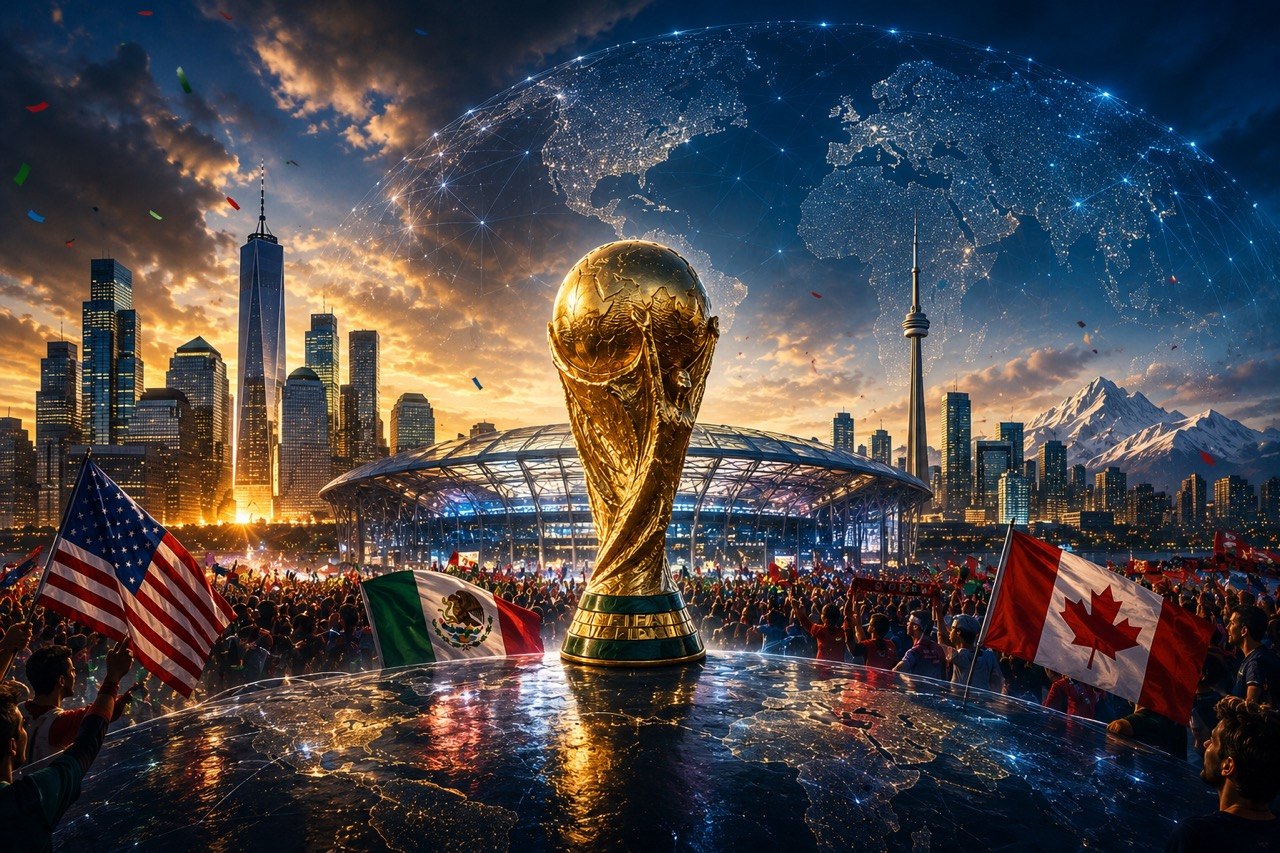
Cover photo: CEA Magazine. Edited with AI assistance using ChatGPT

David R. Hohl is an economic historian and researcher focused on Central European economic transformation, innovation, and regional development. His work combines historical insight with contemporary economic analysis, supported by international research collaborations across Europe.
Support independent analysis and journalism at CEA Magazine: https://centraleuropeanaffairs.com/donation
For more insights on Central European political risk, EU institutional developments, and transatlantic relations, follow CEA Magazine and the CEA Talk podcast.
